

What Is an OBD2 Scanner? How It Works, What It Can Do & How to Use One
Modern vehicles are packed with sensors and electronic control systems designed to monitor everything from engine performance and emissions to fuel delivery and transmission operation. When something goes wrong, your vehicle’s On-Board Diagnostics (OBD) system can often provide valuable information about the problem.
That’s where an OBD2 scanner comes in.
An OBD2 scanner is a diagnostic tool that communicates with your vehicle’s computer to retrieve information about its systems and identify diagnostic trouble codes (DTCs). For professional technicians, it’s an essential diagnostic tool. For DIY vehicle owners, it can provide a better understanding of what’s happening under the hood before spending money on repairs.
But what exactly does an OBD2 scanner do? How do you use one? And can owning one actually save you money?
Let’s break it down.
What Is an OBD2 Scanner?
OBD2, or On-Board Diagnostics II, is a standardized vehicle diagnostic system used on most modern vehicles.
The system continuously monitors various components and systems in your vehicle. When it detects a problem, it can store a diagnostic trouble code and, depending on the issue, illuminate the Check Engine Light.
An OBD2 scanner connects to the vehicle’s OBD2 diagnostic port and communicates with the vehicle’s computer to retrieve these codes and other diagnostic information.
The diagnostic port is usually located underneath the dashboard on the driver’s side.
Depending on the scanner, you may be able to see:
- Diagnostic trouble codes
- Live sensor data
- Engine RPM
- Coolant temperature
- Vehicle speed
- Oxygen sensor readings
- Fuel system information
- Battery/charging voltage
- Emissions readiness monitors
- Freeze-frame data
More advanced professional scan tools can access significantly more vehicle information and perform additional diagnostic functions.
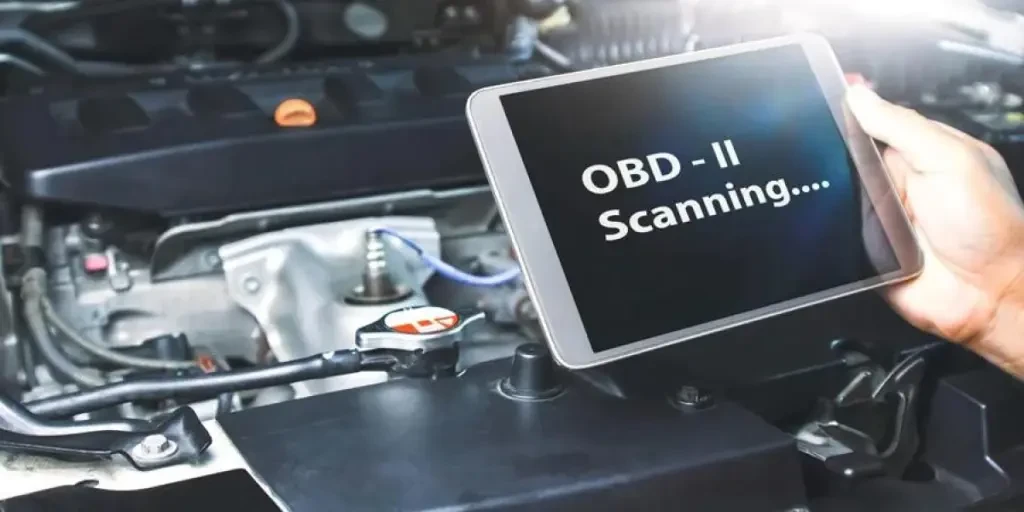
How Does an OBD2 Scanner Work?
The process is relatively simple.
Your vehicle has multiple electronic control modules and sensors that monitor different systems. When a problem is detected, the relevant control module can store a diagnostic code.
When you connect an OBD2 scanner, it communicates with the vehicle’s diagnostic system and retrieves the available information.
Think of the scanner as a translator between you and your vehicle’s computer.
Instead of simply seeing a Check Engine Light, you can retrieve a code such as P0301, which indicates a cylinder-specific misfire on cylinder 1.
However, it’s important to understand that an OBD2 code doesn’t always identify the exact component that needs replacement. It identifies a system or condition that requires further diagnosis.
That’s why professional technicians often combine scan-tool information with physical inspections and additional testing.
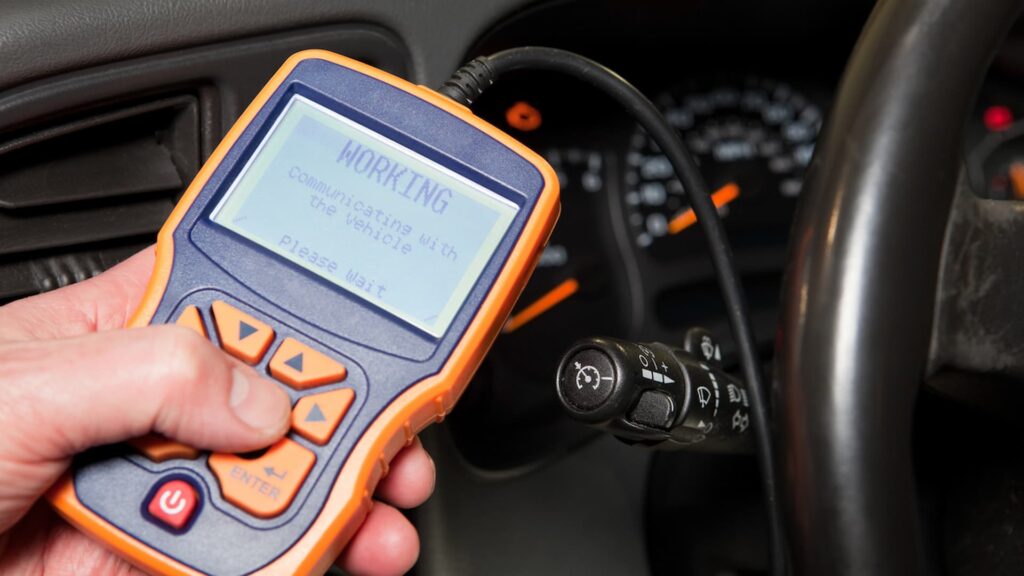
How to Use an OBD2 Scanner in 5 Easy Steps
Using a basic OBD2 scanner doesn’t require you to be a professional mechanic.
Step 1: Locate the OBD2 Port
Look underneath the dashboard on the driver’s side. The port is usually within easy reach of the driver’s seat.
If you can’t find it, check your vehicle’s owner’s manual.
Step 2: Plug In the Scanner
Turn the vehicle’s ignition to the appropriate position, usually with the engine off initially, and connect the scanner to the OBD2 port.
Some scanners receive power directly from the vehicle through the diagnostic port, while wireless scanners may communicate with a smartphone or tablet.
Step 3: Turn on the Ignition
Follow the scanner’s instructions to establish communication with the vehicle.
Depending on the scanner and vehicle, you may be asked to select the vehicle’s year, make, model, or engine.
Step 4: Read the Codes
Select the option to Read Codes or Scan for Codes.
The scanner will retrieve stored or pending diagnostic trouble codes.
Write down the codes before clearing anything.
Step 5: Research and Diagnose the Problem
Look up the meaning of the code and investigate the possible causes.
Remember: a trouble code is a starting point for diagnosis, not automatically a parts replacement recommendation.
What Can an OBD2 Scanner Actually Tell You?
One of the biggest misconceptions about OBD2 scanners is that every scanner provides the same information.
They don’t.
A basic code reader may simply display and clear trouble codes, while an advanced scan tool can provide extensive live data and diagnostic functions.
Depending on the scanner, you may be able to monitor:
Engine Performance
You can view information from various engine sensors and systems to help identify performance problems.
Emissions Systems
OBD2 systems play an important role in monitoring emissions-related components. A scanner can help identify faults affecting systems such as oxygen sensors, EVAP systems and catalytic converters.
Live Data
Some scanners allow you to view sensor readings in real time while the engine is running.
This can be particularly useful when diagnosing intermittent or performance-related problems.
Freeze-Frame Data
When certain faults occur, the vehicle may capture operating conditions at the time the fault was detected.
This can provide valuable clues during diagnosis.
Readiness Monitors
OBD2 scanners can also show whether certain emissions-related monitors have completed their self-tests.
This can be particularly useful when preparing for emissions testing, depending on local requirements.
OBD1 vs OBD2: What's the Difference?
If you’ve worked on older vehicles, you may have heard the term OBD1.
OBD1 was an earlier generation of vehicle diagnostic systems. However, manufacturers used different systems and connectors, making diagnostics less standardized.
OBD2 introduced greater standardization and expanded diagnostic capabilities.
Here’s a simplified comparison:
|
Feature
|
OBD1
|
OBD2
|
|---|---|---|
|
Era
|
Older vehicles
|
Newer vehicles
|
|
Standardization
|
More manufacturer-specific
|
More standardized
|
|
Connector
|
Varies
|
Standard 16-pin connector
|
|
Diagnostic capability
|
More limited
|
More extensive
|
|
Emissions monitoring
|
Less comprehensive
|
More comprehensive
|
|
Modern scanner compatibility
|
Limited
|
Widely supported
|
If you own a modern vehicle, you’ll generally be looking for an OBD2-compatible scanner.
Can an OBD2 Scanner Save You Money?
Potentially, yes.
One of the biggest advantages of owning an OBD2 scanner is that it can help you make more informed repair decisions.
Imagine your Check Engine Light comes on.
Without any diagnostic information, you might visit a repair shop and simply say, “My Check Engine Light is on.”
With an OBD2 scanner, you can retrieve the diagnostic code and have a better idea of which system needs attention.
This doesn’t mean you should diagnose every problem yourself or automatically replace the component associated with a code.
Instead, the scanner can help you:
- Understand what system may be affected
- Avoid unnecessary parts replacement
- Identify problems earlier
- Communicate more effectively with a mechanic
- Monitor whether a repair has resolved a problem
- Diagnose minor issues yourself when appropriate
For DIY enthusiasts who regularly maintain their vehicles, the ability to perform basic diagnostics can make an OBD2 scanner a worthwhile investment.
Can Every OBD2 Scanner Diagnose Every Problem?
No.
This is another important distinction.
A basic OBD2 scanner is primarily designed to retrieve diagnostic information from supported vehicle systems. It doesn’t replace a professional diagnostic tool or a trained technician.
Some problems may not trigger a diagnostic code at all.
For example, mechanical issues, physical damage, worn components, or certain intermittent problems may require additional testing.
More advanced scan tools can provide access to additional modules and functions, including manufacturer-specific systems and advanced diagnostic capabilities.
So when choosing a scanner, consider what you actually need it to do.
What Should You Look for When Buying an OBD2 Scanner?
If you’re buying your first scanner, don’t automatically choose the cheapest option.
Consider these features:
Code Reading and Clearing
At minimum, the scanner should be able to read the diagnostic codes relevant to your vehicle.
Live Data
This is extremely useful for troubleshooting sensor and engine performance issues.
Freeze-Frame Data
Helpful for understanding the conditions present when a fault was detected.
Vehicle Compatibility
Always verify that the scanner supports your vehicle before purchasing.
Wired vs. Wireless
Wireless scanners can connect to smartphones and provide convenient mobile diagnostics, while traditional handheld scanners offer a dedicated interface.
Advanced Functions
If you’re a professional technician or serious DIYer, you may want features such as ABS/SRS diagnostics, service resets, bidirectional controls, or access to additional vehicle modules.
Final Thoughts: Is an OBD2 Scanner Worth Having?
For today’s vehicles, an OBD2 scanner can be one of the most useful diagnostic tools for both DIY vehicle owners and automotive professionals.
It can help you understand why a Check Engine Light has appeared, retrieve diagnostic trouble codes, monitor live vehicle data, and make more informed decisions about repairs.
But remember: an OBD2 scanner doesn’t magically diagnose every problem. The information it provides is a starting point that needs to be interpreted correctly.
Used properly, however, it can help take some of the guesswork out of vehicle maintenance—and potentially save you time and money.
Get the Right Diagnostic Tools & Parts from West Can Auto Parts
Once you’ve identified the system causing a problem, having the right diagnostic tools and quality replacement parts is the next step.
At West Can Auto Parts, we offer a wide selection of automotive diagnostic tools, replacement parts, accessories, and professional equipment for DIYers, automotive enthusiasts, and professional technicians. Whether you’re looking for an OBD2 scanner, ignition components, sensors, filters, brakes, batteries, or other replacement parts, our knowledgeable team can help you find the right solution for your vehicle.
With quality products, trusted brands, competitive pricing, and knowledgeable service, West Can Auto Parts is your one-stop destination for automotive parts, tools, and equipment.
Need an OBD2 scanner or the parts to complete your repair? Visit West Can Auto Parts or shop online today and get the tools and parts you need to diagnose, repair, and keep your vehicle running right.
Disclaimer:
This blog is for educational and informational purposes only. For accurate diagnosis and proper vehicle repairs, always consult a certified automotive technician.